ISO 13849-1 Verification Readiness
Identify compliance gaps. Understand verification blockers. Establish a clear route forward.
Independent, structured assessment of machinery safety-related control systems to identify gaps against ISO 13849-1 and define the actions required before progressing to full design verification.
Is Your Safety Control System Ready for Verification?
Demonstrating compliance with ISO 13849-1 requires more than selecting safety rated components and completing performance level calculations.
Safety functions must be adequately specified, the control system architecture must be suitable, wider qualitative requirements reviewed, and the design must be supported by sufficient documentation and evidence.
For many machinery projects, significant gaps only become apparent when formal verification is attempted.
SIM Safety’s Verification Readiness Gap Assessment helps engineering teams identify these issues earlier, understand their significance and establish a practical route toward compliance.
A Structured Assessment Before Full Verification
Our Verification Readiness Gap Assessment provides an independent technical review of the available safety requirements specification, design and supporting documentation.
The assessment is intended to establish the system’s current verification readiness, identify significant deficiencies and provide prioritised and practical recommendations for corrective action.
Unlike a full design verification assessment, the focus is on identifying and diagnosing gaps rather than completing detailed verification calculations and compiling the final evidence of conformity.
This provides a practical starting point for projects where design maturity or documentation completeness is uncertain.
A successful readiness assessment can provide useful evidence and help address issues ahead of formal verification.
What does the Assessment cover?
-
Suitability and completeness of the defined safety functions and associated requirements, including Performance Level Requirements (PLr).
-
Review of the proposed control system structure in terms of category and behaviour under fault conditions.
-
Suitability of safety-related components and availability of supporting reliability data (B10d, MTTFd).
-
Review of the basis for required performance levels and the information available to support their verification.
-
Review of fault detection, monitoring arrangements and relevant diagnostic principles.
-
Consideration of relevant design measures, including common cause failures and other applicable ISO 13849-1 requirements.
-
Identification of missing or inadequate information required for subsequent verification.
A successful readiness assessment can provide useful evidence and help address issues ahead of formal verification.
What will you receive?
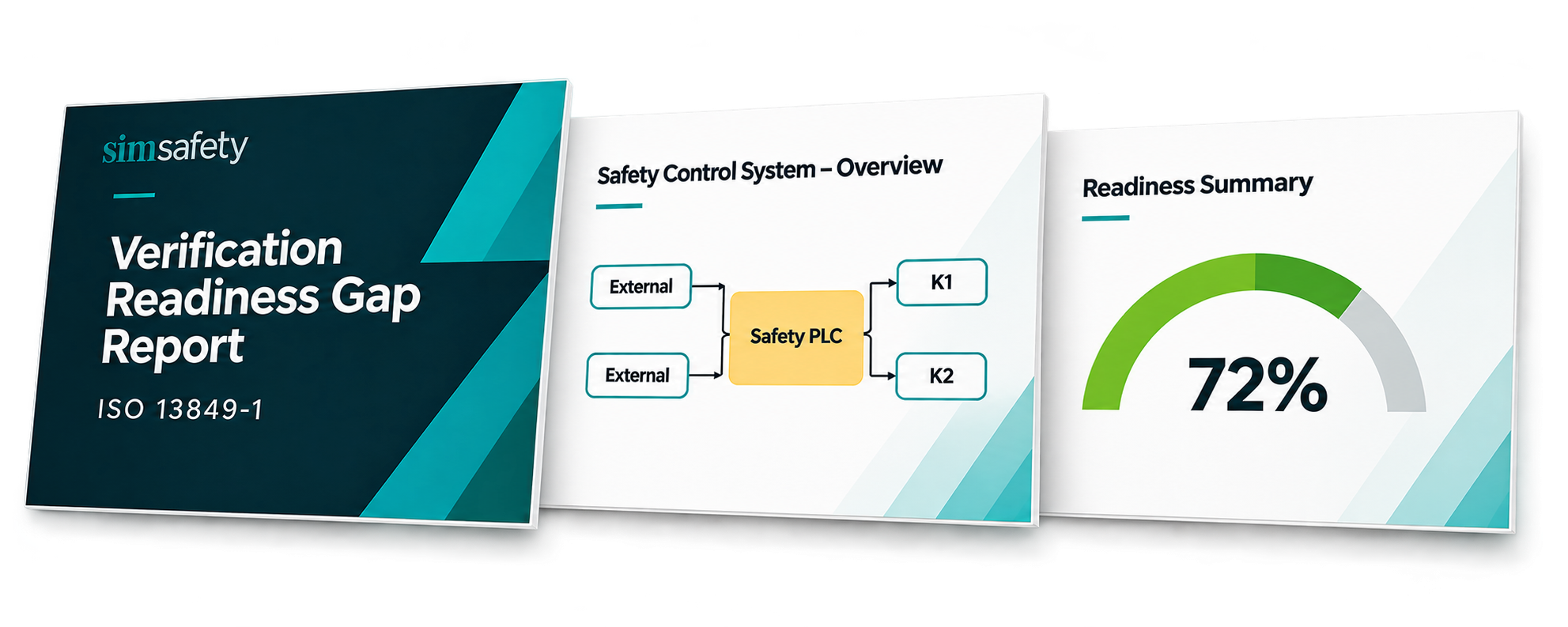
A structured Verification Readiness Gap Report documenting the assessment findings and recommended next steps.
The report provides:
An overview of the safety system and assessment scope.
A structured review of the available specification and design information.
Infographics used to show hardware layouts and safety function architecture scoring.
Identification of significant compliance gaps and verification blockers.
Clear technical explanations of identified deficiencies.
Prioritised recommendations for corrective action.
An assessment of readiness to progress toward detailed design verification.
The aim is to provide your engineering team with a clear understanding of what needs attention, why it matters and how to move forward
Who is this Service For?
This assessment is particularly for:
Machine Builders
Machine builders seeking independent review of an existing safety control system design.
Systems Integrators
Systems integrators undertaking machinery safety upgrades.
Engineering Teams
Engineering teams preparing for formal ISO 13849 verification.
Machinery Owners
Machinery owners undertaking safety improvement programmes.
Evolving Projects
Projects where safety documentation is incomplete or has evolved during design.
Organisations
Organisations lacking the internal resources or specialist expertise to assess verification readiness.
REVIEW
Assess existing systems, documentation and design approach.
IDENTIFY
Highlight gaps, risks and opportunities for improvement.
IMPROVE
Provide practical, industry-aligned recommendations.
PREPARE
Build confidence for formal ISO 13849 verification.
ACHIEVE
Establish a clearer route towards a verification-ready design.
How does the Process Work?
Readiness Assessment or Full Design Verification?
Verification Readiness Gap Assessment
Designed for projects where the suitability or completeness of the specification, design or supporting evidence is uncertain. The objective is to identify deficiencies and establish corrective actions before committing to full verification. This is normally the best place to start for most scenarios and assessment work can be carried over towards Full Design Verification Assessment.
Full Design Verification Assessment
Intended for sufficiently mature systems with the required specification, design information and supporting evidence available. This involves detailed assessment, calculations and documentation of verification results against applicable ISO 13849-1 requirements.
The Readiness Gap Assessment does not constitute formal confirmation of compliance but helps establish whether the project is adequately prepared for that next stage.
Frequently Asked Questions
-
Not necessarily. The assessment can identify deficiencies in the existing specification and recommend the additional information required.
-
Yes. The service can support new machinery, existing designs and safety-related control system upgrades, subject to an agreed scope.
-
The report provides practical, prioritised recommendations for addressing identified deficiencies. Detailed redesign or development of corrective solutions can be considered separately where required.
-
Whether you are preparing for commissioning, reviewing an existing design or undertaking a machinery safety upgrade, SIM Safety can help establish the current verification readiness of your safety-related control system.
Discuss Your Verification Requirements